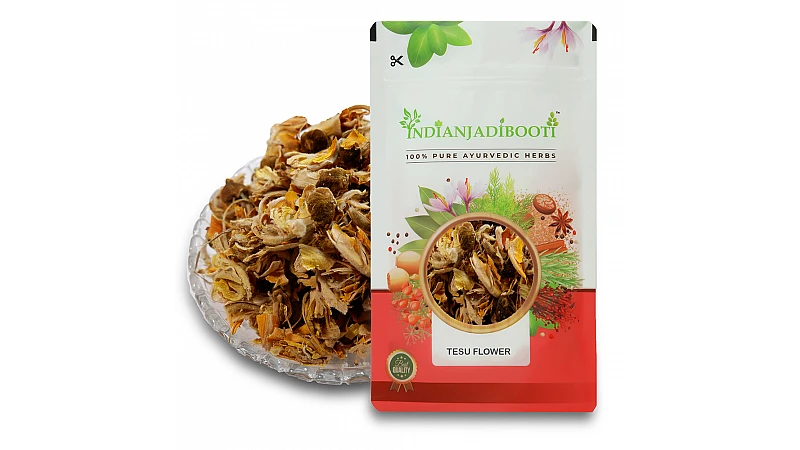
Tesu Flower (Palash Phool): Uses, Benefits, Holi Colour, Research & Safety

Quick answer: Tesu flower, Palash phool, Dhak flower and Kesuda flower are regional names for the bright orange flowers of Butea monosperma, a tree in the pea family. The dried flowers are best known for making a traditional orange-yellow water colour for Holi and for cultural, decorative and botanical uses. Laboratory research has identified natural pigments and several plant compounds in the flowers, but reliable human clinical evidence is not available to prove that Tesu flower treats diabetes, liver disease, infections, arthritis or other medical conditions.

Tesu is one of the most recognisable seasonal flowers of the Indian subcontinent. When the tree loses much of its foliage and becomes covered in vivid orange blossoms, the canopy appears to glow—hence the English name Flame of the Forest. Across India, the same flower may be called Palash, Dhak, Kesuda, Kesu, Polash, Kinshuk, Muthuga or Moduga.

Its cultural importance is matched by a long history of traditional use. The flowers have been soaked in water to prepare festive colour, used in rituals and seasonal customs, studied as a source of natural pigments, and described in traditional herbal literature. However, the flower, seed, bark, leaf and gum are different materials. Their uses, chemistry and safety cannot be treated as interchangeable.

What Is Tesu Flower?

Tesu flower is the dried or fresh flower of Butea monosperma. The accepted botanical name is Butea monosperma (Lam.) Kuntze. It belongs to the Fabaceae family, the same broad plant family that includes peas and beans. Butea frondosa appears in older books and trade descriptions, but modern botanical databases treat it as a synonym rather than a separate species.

Identity point Correct description
Accepted botanical name Butea monosperma (Lam.) Kuntze
Plant family Fabaceae
English common names Flame of the Forest, Bengal Kino tree, Dhak tree
Hindi names Palash phool, Tesu phool, Dhak phool
Gujarati names Kesuda, Kesudo, Khakhro
Older botanical synonym Butea frondosa
Product discussed here Dried whole flowers—not seeds, gum, bark or leaves

Kew’s Plants of the World Online lists the species as native from the Indian subcontinent through parts of mainland Southeast Asia and southern China. The Jharkhand Biodiversity Board also identifies Palash as the state flower of Jharkhand, reflecting its cultural and ecological importance.

Tesu, Palash, Dhak and Kesuda: Are They the Same?

For the flower product, these names generally refer to the same botanical species, although spelling and pronunciation vary by language and region.

  • Tesu / Teshu: common in Hindi-speaking regions, especially in connection with Holi colour.
  • Palash / Palaash / Palas: widely used in Hindi, Sanskrit-derived and trade contexts.
  • Dhak / Dhaak: another common North Indian name for the tree and flower.
  • Kesuda / Kesudo / Kesu: frequently used in Gujarat and western India.
  • Polash: a common Bengali transliteration.
  • Moduga / Muthuga: regional names used in parts of southern India.
  • Kinshuk: a classical literary name associated with the flower’s vivid colour.

Searches such as “Tesu flower in English,” “Kesuda flower in English” and “Palash phool in English” usually refer to Flame of the Forest flower. The botanical name is more precise than any regional translation.

What Does the Palash Tree Look Like?

Butea monosperma is a deciduous tree. It is particularly striking during its flowering period because many leaves fall before or while the flowers appear. Clusters of curved, orange to vermilion blossoms cover the branches and create the flame-like appearance for which the tree is famous.

The tree usually has compound leaves made of three large leaflets. This three-leaf pattern is connected with the familiar Hindi expression “ढाक के तीन पात” (dhak ke teen paat). The flowers have the pea-family form: a standard petal, two wing petals and a strongly curved keel.

Flowering time varies with geography and seasonal conditions, but Palash commonly blooms in late winter and spring in many parts of India. Dried flowers are lighter, less vivid and more brittle than fresh blossoms. Natural colour variation is expected because harvest time, drying, storage and age all influence appearance.

Palash Flower Is Not the Same as Palash Seed, Gum, Bark or Leaf

Many online articles combine every part of the Palash tree into one list of “benefits.” That is misleading. Different plant parts contain different compounds and have different traditional uses and safety concerns.

Plant part Common trade name Typical use context
Flower Tesu phool, Palash phool, Kesuda flower Natural colour extraction, cultural use, botanical study and traditional preparations
Seed Palash beej, Dhak beej, Bilas Papda A separate raw-herb material with different traditional uses and greater safety concerns
Gum Palash gond, Kamarkas, Gond Chuniya Resinous exudate used in separate food and traditional preparations
Bark and root Palash bark/root Professional traditional-herbal context; not interchangeable with flowers
Leaf Palash patta Traditional plates, ritual use and plant identification

Important: A study reporting an effect from Palash seed extract does not prove the same effect for dried flowers. Likewise, a laboratory experiment on a purified flower compound does not establish that a homemade tea or paste will produce the same result in people.

Traditional and Practical Uses of Tesu Flower

1. Natural Orange-Yellow Colour

The best-established practical use of Tesu flower is as a source of natural colour. Water extracts can develop shades ranging from golden yellow to orange, depending on flower quality, amount of water, extraction time, temperature and concentration. The colour comes from multiple plant pigments rather than one single chemical.

A 2023 study used hot-water extraction of dried Butea monosperma petals and isolated an orange dye. Researchers identified marker compounds including iso-coreopsin, butrin and iso-butrin. This supports the flower’s value as a natural colour source, although laboratory extraction and quality testing are more controlled than household preparation.

2. Holi and Seasonal Celebrations

Tesu water has a long association with Holi. Fresh or dried flowers are soaked to release colour into water. The resulting colour is used as a traditional alternative to brightly coloured synthetic powders or liquids.

“Natural” should not be confused with “guaranteed allergy-free.” Flowers can contain dust, pollen, microbes or residues from handling. Anyone with sensitive skin should patch-test the strained liquid first, avoid the eyes and mouth, and stop use if irritation develops.

3. Cultural, Ritual and Decorative Use

Palash has a significant place in Indian seasonal, religious and literary traditions. Its flowers may be used for decoration, offerings, craft work and educational displays. The tree’s striking colour and three-leaf form have made it a familiar symbol in folklore and poetry.

4. Natural-Dye and Material Research

Researchers have studied Palash flower pigments for textiles, food-colour research, cosmetics, analytical markers and even light-harvesting applications. These studies show that the flower is chemically interesting, but they do not turn a raw dried flower into a standardized medicinal or cosmetic ingredient.

5. Traditional Herbal Context

Traditional literature describes uses for Palash flowers and other parts of the tree. These records are historically important, but modern evidence must be evaluated separately. A traditional-use description should not be rewritten as a guaranteed cure, a medical dosage or a replacement for clinical treatment.

How to Make Tesu Flower Water Colour for Holi

The following method is intended for an external festive colour, not as a medicinal drink.

  1. Inspect the flowers: Remove visible dust, foreign material, insects or mouldy pieces.
  2. Rinse briefly: A quick rinse can remove loose surface dust. Do not soak in dirty or reused water.
  3. Cover with clean water: Place the flowers in a clean container and add enough water for them to move freely.
  4. Allow time for extraction: Soak for several hours or overnight. For a deeper shade, warm the mixture gently and then allow it to cool completely.
  5. Strain carefully: Remove petals and fine particles using a clean cloth or fine strainer.
  6. Patch-test: Apply a small amount to the forearm and wait before broader skin use, especially for children or sensitive skin.
  7. Use fresh: Water-based flower extracts can spoil. Prepare close to the time of use and discard if the liquid develops an unpleasant smell, foam or visible growth.

The shade may not resemble commercial neon colour. Natural Tesu water is usually softer and can vary from yellow-gold to orange. Stronger colour is not proof of higher purity; unusually fluorescent or persistent colour may indicate added dye.

What Modern Research on Tesu Flower Shows

Modern research can be grouped into four levels: botanical identification, chemical analysis, laboratory activity, and human clinical evidence. These levels should not be treated as equal.

Research level What has been studied What it can tell us
Botanical and anatomical studies Flower structure, microscopy, pollen, trichomes and identification markers Helps authenticate the plant material and detect substitution
Chemical analysis Butein, butrin, isobutrin, iso-coreopsin and other compounds Shows which molecules may contribute to colour or laboratory activity
Cell and test-tube studies Antioxidant assays, enzyme inhibition, inflammatory markers and cell-line effects Identifies possible mechanisms for further study; does not prove a health benefit in people
Animal studies Experimental models involving liver injury, inflammation, glucose regulation and other outcomes Provides early biological evidence but cannot establish human dose, safety or effectiveness
Human clinical trials Reliable trials of dried Tesu flower for common treatment claims Currently insufficient to support disease-treatment claims

Natural Pigments and Marker Compounds

The 2023 ACS Omega study is especially relevant to ordinary users because it investigated a water-extracted colour from flower petals. It reported an orange dye powder and identified iso-coreopsin, butrin and iso-butrin as marker compounds. The experiment demonstrates that Palash petals can provide a measurable natural colour through hot-water extraction.

Laboratory Antioxidant and Anti-inflammatory Findings

Studies have isolated compounds such as butein, butrin, isobutrin, sulfuretin and kaempferol from the flowers. Some have shown antioxidant, enzyme-inhibiting or anti-inflammatory activity in laboratory systems. A 2026 natural-products study, for example, tested isolated flower compounds in chemical assays and cultured cells.

These results are scientifically useful but remain preclinical. Concentrations used in a laboratory may not be achieved by soaking a few dried flowers in water. The activity of an isolated molecule also cannot be assumed for every raw flower batch.

Animal Research

Several animal experiments have examined Palash extracts in models of liver injury, inflammation, diabetes and other conditions. Such studies can suggest biological pathways worth investigating. They do not establish that Tesu flower prevents or treats hepatitis, jaundice, diabetes, arthritis, urinary infection, heat stroke or any other disease in humans.

Evidence summary: Tesu flower has credible botanical, pigment and preclinical research. It does not currently have the level of human clinical evidence required to support confident treatment claims, fixed medicinal dosages or statements that modern research has “validated” dozens of health benefits.

Tesu Flower Benefits: What Can Be Said Responsibly?

The word “benefit” can refer to practical, cultural or research value—not only medical treatment. The strongest supported benefits of Tesu flower are:

  • Natural colour source: water can extract orange-yellow pigments from dried petals.
  • Cultural value: the flower is closely linked with Holi, seasonal traditions, art and ritual.
  • Botanical value: it is a distinctive native Asian tree with ecological and cultural significance.
  • Research value: its pigments and flavonoids are being investigated for food-colour, cosmetic, material and pharmaceutical applications.
  • Commercial value: dried flowers are used by households, artisans, natural-colour makers, researchers and bulk buyers.

Traditional texts and folk practices may describe broader health uses. Those descriptions can be presented as traditional context, but not as proof that the flower cures disease. In particular, claims about liver detoxification, diabetes control, blood purification, infections, menstrual pain, joint disease, cataracts, piles or night blindness go beyond the available human evidence.

Can Tesu Flower Be Used in Food or Drinks?

Traditional culinary and beverage uses are reported in some communities, and researchers have studied a water-extracted Palash pigment as a food-grade dye under controlled laboratory conditions. However, a research-grade extraction process does not mean that every dried flower sold online is automatically suitable for eating.

Before internal use, check whether the actual product is explicitly supplied and handled as a food ingredient. Flowers intended for colour, ritual, craft or external use may not have the same cleaning, testing, traceability or contaminant controls required for food use.

Do not assume “natural” means edible. Avoid oral use when the source, plant part, batch quality or food-grade status is uncertain. Pregnant or breastfeeding individuals, children, people taking medicines and anyone managing a medical condition should obtain qualified advice before internal use.

How to Identify and Buy Good Dried Tesu Flowers

  • Correct plant part: the pack should contain dried flowers, not seeds, bark fragments or gum.
  • Natural colour: shades may range from muted yellow-orange to reddish orange. Very bright uniform colour may require closer inspection.
  • Dry texture: flowers should feel dry rather than damp, sticky or slimy.
  • Clean aroma: mild plant-like or earthy notes are normal; musty, fermented or chemical odours are not.
  • No visible mould: avoid grey, fuzzy or damp patches.
  • Low foreign matter: small natural stems may occur, but stones, plastic, excessive dust and unrelated plant pieces should not.
  • Traceable seller: choose a supplier that clearly identifies the botanical name, flower form, pack size and storage guidance.
  • Use-specific quality: food, cosmetic, research and festival-colour applications may require different testing and documentation.

Dried flowers naturally fade over time. Colour loss alone does not always mean adulteration, but old, poorly stored flowers may produce a weaker extract.

Explore Dried Tesu Flower

View available retail and bulk pack sizes of dried Tesu flower, also known as Palash phool, Dhak flower and Kesuda flower.

Check Pack Sizes & Price

How to Store Dried Palash Flowers

  • Keep the flowers in an airtight container or properly sealed pouch.
  • Store away from direct sunlight, heat and humidity.
  • Use a dry hand, spoon or scoop when removing flowers.
  • Do not store beside strongly scented chemicals, incense or cleaning agents.
  • In humid weather, inspect periodically for moisture, insects and mould.
  • Discard material that develops an unpleasant smell, damp clumps or visible fungal growth.

Light and oxygen gradually affect natural pigments. A cool, dark cupboard helps preserve colour better than an open transparent container near a window.

Safety and Precautions

For External Colour Use

  • Rinse and strain the flowers before preparing colour.
  • Patch-test the final liquid on a small skin area.
  • Avoid contact with eyes, mouth, broken skin and irritated areas.
  • Stop use if burning, itching, redness or swelling occurs.
  • Do not add synthetic colour, fragrance oil or unknown powder to a skin preparation.
  • Supervise children and prevent swallowing of the flowers or concentrated liquid.

For Internal Use

  • Reliable human safety and dosing data for ordinary dried Tesu flower are limited.
  • Do not use disease-treatment recipes from general websites as a substitute for medical care.
  • Avoid internal use during pregnancy or breastfeeding unless specifically advised by a qualified professional.
  • Seek advice before use with medicines, allergies, liver or kidney disease, or before surgery.
  • Do not assume flower research applies to Palash seeds; seed material has separate toxicity concerns.

For Cosmetic or Commercial Formulation

Raw flowers are not the same as a standardized cosmetic extract. Commercial products require appropriate microbial, contaminant, stability, compatibility and skin-safety testing. A laboratory paper describing an isolated compound does not establish a safe concentration for a homemade cream or serum.

Frequently Asked Questions

What is Tesu flower called in English?

Tesu flower is commonly called Flame of the Forest flower. It is the flower of Butea monosperma.

Are Tesu flower and Palash flower the same?

Yes. Tesu, Palash and Dhak are widely used regional names for the same tree and flower, Butea monosperma.

What is Kesuda flower in English?

Kesuda or Kesudo flower is commonly translated as Flame of the Forest flower. The botanical name is Butea monosperma.

Is Butea frondosa different from Butea monosperma?

Butea frondosa is an older botanical synonym. The accepted name used by Kew is Butea monosperma.

Why is Palash called Flame of the Forest?

During flowering, clusters of bright orange-red flowers can cover largely leafless branches, making the tree appear like a flame across the landscape.

Can dried Tesu flowers make Holi colour?

Yes. Dried flowers can be soaked or gently warmed in water and strained to produce a natural yellow-orange water colour.

Is natural Tesu colour safe for everyone?

No natural material is guaranteed allergy-free. Use clean flowers, strain the liquid, patch-test first and avoid the eyes, mouth and broken skin.

Can Tesu flower colour be stored?

Fresh water extracts can spoil. It is better to prepare them close to use, keep them cool for a short period and discard them if odour, foam or visible growth develops.

Is Tesu flower edible?

Traditional food uses and controlled food-colour research exist, but not every dried flower batch is food grade. Consume only when the product is expressly supplied for food use and the source and guidance are reliable.

Does Tesu flower cure diabetes or liver disease?

No reliable human clinical evidence establishes dried Tesu flower as a treatment for diabetes, hepatitis, jaundice or other liver disease. Laboratory and animal studies should not be presented as proven treatment.

Is Palash flower the same as Palash seed?

No. Flowers and seeds are different plant parts. They have different traditional uses, chemistry and safety considerations.

How should dried Tesu flowers be stored?

Keep them airtight in a cool, dry and dark place. Protect them from moisture, insects, direct sunlight and strong odours.

What gives Tesu flowers their colour?

Researchers have identified several natural pigments and flavonoid compounds, including butrin, isobutrin, iso-coreopsin and butein. The exact profile varies by sample and extraction method.

Is Palash the state flower of Jharkhand?

Yes. The Jharkhand Biodiversity Board identifies Palash as the state flower of Jharkhand.

Research and Botanical References

  1. Kew Plants of the World Online: Butea monosperma — accepted name, synonyms and native distribution.
  2. Negi P. et al. Isolation of food-grade dye from flower petals of Butea monosperma. ACS Omega, 2023.
  3. Anatomical investigation of the flower of Butea monosperma.
  4. Review of Butea monosperma phytochemistry, environmental value and preclinical research.
  5. Study of antioxidant, anti-melanogenic and anti-inflammatory constituents isolated from the flowers, 2026.
  6. Laboratory study of butein and flower extracts.
  7. Jharkhand Biodiversity Board: state flower information.

Conclusion

Tesu flower is much more than a generic “medicinal flower.” It is a botanically distinct, culturally important source of natural orange-yellow colour with a growing body of pigment and laboratory research. The most responsible way to describe it is to separate established uses from early scientific findings.

For most households, the clearest practical uses are natural Holi colour, decoration, ritual and botanical applications. Medical treatment claims remain unproven in humans, and the flower should never be confused with Palash seed, gum, bark or leaf. Correct identity, clean handling, careful storage and use-specific quality are more meaningful than exaggerated promises.